
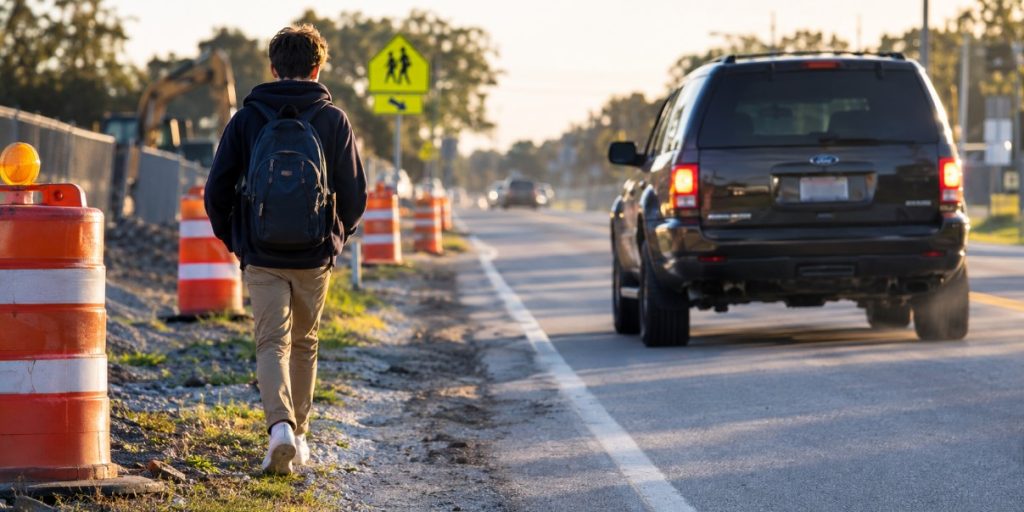
A walk to school ended in a medical emergency for a 14-year-old Treasure Coast High School freshman after an SUV struck him from behind along Southwest Port St. Lucie Boulevard.
The student suffered life-threatening injuries in the October 7 collision and remained in critical condition in a pediatric intensive care unit the following morning. Police are investigating what happened, while neighbors have raised concerns about a stretch of roadway under construction that reportedly lacks sidewalks.
For the student’s family, the immediate priority is his recovery. The crash also raises important questions about driver attention, pedestrian access, and how children can safely reach school when their route passes through roadwork.
What Happened Near Southwest Squirrel Avenue
According to Port St. Lucie Police, the crash occurred around 6 a.m. on Wednesday, October 7, 2026, near Southwest Port St. Lucie Boulevard and Southwest Squirrel Avenue. The teenager was walking northbound toward school near the edge of the roadway, alongside construction barrels, when a northbound 2002 Ford Excursion driven by a 72-year-old man struck him from behind.
Investigators said the driver initially believed he had hit a construction barrel. He made a U-turn, returned to the scene, found the student unconscious along the roadside, and called 911.
In an October 8 update, a police spokesperson confirmed that the student remained hospitalized in critical condition and that investigators had not been advised of any improvement. Police are seeking witnesses and video footage as the investigation continues.
The preliminary assessment found no apparent signs of driver impairment, but police emphasized that the investigation remained ongoing. No final determination of fault has been reported.
The reported return to the scene and call for help are important: this should not be characterized as a hit-and-run.
Driver Lookout Matters Even Without Impairment
A driver does not have to be impaired to cause a preventable pedestrian collision. The absence of apparent alcohol or drug impairment does not resolve whether the driver maintained a proper lookout, traveled at an appropriate speed, or had time to recognize and avoid a person ahead.
Florida Statute § 316.130(15) requires every driver to exercise due care to avoid colliding with a pedestrian. It also requires proper precautions upon observing a child or an obviously confused or incapacitated person.
That duty makes the moments before impact especially important in this case. The investigation should establish where the student was walking, where the SUV was traveling, what the driver could see, and whether a reasonably careful driver could have avoided the collision.
The driver’s reported belief that he struck a barrel does not, by itself, establish negligence or excuse the impact. It is one fact investigators must assess alongside visibility, vehicle position, physical evidence, and any available video.
Construction Barrels Raise Questions About the Walking Route
CBS12 reported that the crash area was under construction and lacked sidewalks. Neighbors expressed concerns about the safety of people walking along the corridor after the student was injured.
Those conditions deserve careful examination. But construction activity alone does not prove that a contractor, road agency, or project designer caused the crash.
A thorough investigation should ask:
- Was there a designated pedestrian route through or around the construction area?
- Was that route continuous, accessible, and clearly marked?
- Did barrels or other equipment reduce the space available for walking?
- Did the work-zone arrangement affect the driver’s view of pedestrians?
- Were lighting, signs, barriers, and temporary walking provisions consistent with the project’s approved plans?
- Who controlled the relevant portion of the work zone when the collision occurred?
The answers could help explain whether the roadwork played a role or was simply part of the surrounding scene. Any claim involving construction-zone safety must rest on evidence of a specific duty, a breach of that duty, and a connection to the injury not merely the presence of barrels.
A Pedestrian’s Location Does Not End the Investigation
The precise location of the student matters. Police described him as walking near the edge of the roadway alongside construction barrels, but the reviewed reports do not fully establish his position relative to the travel lane, shoulder, or any available walking space.
Florida’s pedestrian law addresses walking along roads where sidewalks are unavailable. It generally directs pedestrians, when practicable, to walk on the left shoulder facing approaching traffic. The same statute separately preserves every driver’s duty to exercise due care to avoid a pedestrian collision.
An investigation must therefore examine both the available route and the conduct of the people involved. It should not assume that a pedestrian’s presence near a roadway automatically makes the pedestrian responsible. Nor should it assume that a rear impact establishes complete driver fault without reviewing the full evidence.
In this case, the lack of a reported sidewalk makes the practical availability of a safer route a particularly important question.
Evidence That Can Explain How the Crash Happened
A serious pedestrian collision requires more than an initial description of the scene. Families need an investigation that can reconstruct the approach, impact, and available opportunities to avoid harm.
Relevant evidence may include:
- Business and residential surveillance footage.
- Dash-camera recordings from passing vehicles.
- Witness accounts and 911 recordings.
- Photographs and measurements of the roadway, shoulder, and barrel placement.
- The SUV’s damage and available vehicle data.
- Lighting conditions and sightlines at the time of the collision.
- Construction plans, temporary traffic-control records, and site inspection documents.
- Medical records documenting the student’s injuries and treatment needs.
Preserving these materials promptly can help prevent a case from being reduced to competing recollections. Video and scene evidence may show whether the student was visible, whether walking space was restricted, and how the SUV approached.
Potential Civil Responsibility Remains Fact-Dependent
The student’s critical injuries make a complete investigation essential, but the seriousness of the outcome does not automatically establish who is legally responsible. The available reporting supports investigation of the driver’s conduct and the walking environment; it does not yet establish negligence by a particular party.
Depending on the evidence, a civil claim could involve the SUV driver or another party whose proven conduct contributed to the collision. Any work-zone claim would require identifying the responsible entity, its obligations, and the specific condition alleged to have caused harm.
For a family confronting catastrophic injuries, the practical questions extend beyond the crash itself: what treatment will be needed, whether lasting disabilities will result, and what insurance or other recovery may be available. Those questions require a case-specific review rather than assumptions based on an early news report.
A School Route Should Not Become a Dangerous Guess
A child walking to school should not have to guess where it is safe to walk. Drivers approaching roadwork should also recognize that people may be navigating unfamiliar or restricted spaces near the roadway.
The October 7 crash demands answers about both. A teenager was struck from behind near construction barrels and remained critically injured the following morning. The investigation must determine what the driver could see, what route the student could use, and whether reasonable precautions could have prevented the collision.
About Fetterman Law
Families facing a serious pedestrian injury need clear answers not premature conclusions about fault. For Fetterman Law, this case illustrates the importance of investigating driver conduct, preserving video and physical evidence, examining construction conditions, and reviewing available insurance coverage.
If your child or another loved one has been seriously injured in a pedestrian crash, contact Fetterman Law to discuss the circumstances and potential legal options.


